


To Issue 185
Citation: Taylor K, “Late-Stage Material Substitution: Ambition for Sustainability or Transfer-Time Risk?”, ONdrugDelivery, Issue 185 (Apr/May 2026), pp 52–55.
Kiara Taylor delves into the challenges of changing materials to enhance sustainability after a design has been transferred to manufacturing, considering the reasons that might drive such a change, the issues involved and the benefits that can be gained.
Material selection can have a major influence on the environmental impact of a product. Ideally, the materials for a device would have been carefully considered through an environmental lens when initially selected, meaning that there is no need to change them once in production. Unfortunately, that is not the case for every product. If requirements change after design transfer, this presents an opportunity to improve the sustainability of the device, potentially by switching to an alternative material.
Any alteration made during or after transferring a design to manufacturing can have significant repercussions. This is particularly true when the change involves a material substitution, which often sits at the heart of a device’s validated performance, manufacturing process and regulatory justification. In drug delivery products, where material properties directly influence mechanical function, patient safety and drug compatibility, a late-stage material change can trigger a cascade of additional work. Biocompatibility or extractables and leachables testing may need to be repeated, sterilisation compatibility may need to be reassessed and supply chains may require requalification. What might initially appear to be a straightforward substitution can therefore become a substantial engineering and regulatory undertaking.
For this reason, best practice encourages teams to address sustainability considerations early in the design process. Involving relevant stakeholders during concept development and feasibility stages can help to ensure that material choices align with both functional requirements and environmental ambitions. Methods such as early life cycle assessments (LCAs), collaborative stakeholder engagement and multidisciplinary design reviews allow sustainability to be embedded within the design inputs themselves. When this approach is taken, environmentally preferable materials can be evaluated alongside traditional performance metrics such as durability, manufacturability and regulatory acceptability.
“STAKEHOLDER OR CUSTOMER EXPECTATIONS MAY SHIFT LATE IN DEVELOPMENT, FAVOURING MORE SUSTAINABLE OPTIONS THAT WERE NOT PREVIOUSLY PRIORITISED.”
Despite these efforts, situations arise in which material changes become necessary down the line. For example, stakeholder or customer expectations may shift late in development, favouring more sustainable options that were not previously prioritised. This may occur following a corporate acquisition, where new leadership introduces revised environmental strategies and sustainability targets, or based on customer demand. Similarly, a late-stage LCA may reveal that an alternative material could substantially reduce the environmental burden of the product.
In one example, a company sought to improve the sustainability of a self-injection device when it scaled its operations to meet increased demand. This presented a rare opportunity to rethink the design and manufacturing methods to improve efficiency, decrease waste and reduce cost. The suggested changes eliminated the need for three components, thereby reducing material usage and manufacturing energy, as well as decreasing the cost by 16%.
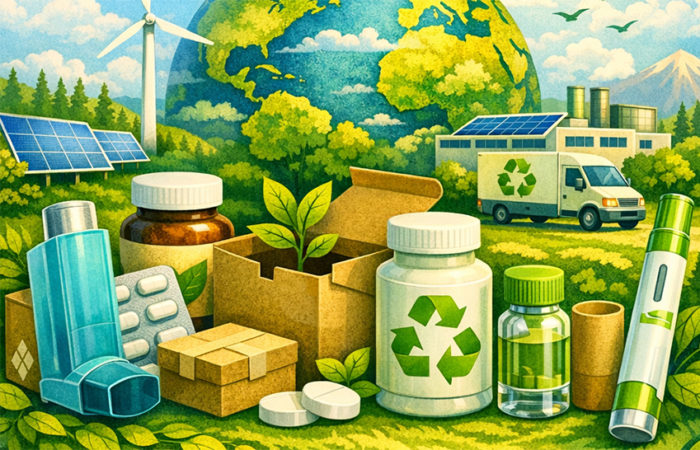
These scenarios highlight a fundamental challenge for the industry – balancing sustainability ambitions with the practical realities of validated manufacturing and regulatory compliance (Figure 1). While late-stage material substitution is never desirable, it is sometimes unavoidable. Understanding how to navigate these changes effectively is therefore becoming an increasingly important skill for engineering teams working on drug delivery technologies.

Figure 1: Sustainability measures can include installing solar panels and wind turbines at manufacturing sites.

Figure 2: Sustainable effervescent tubes manufactured using bio-material.
CASE STUDY
A practical illustration of this challenge can be found in a recently undertaken sustainability initiative. Anticipating consumer packaging preferences, a more sustainable option was introduced within a portfolio of tube packaging used for effervescent tablets (Figure 2). At the time this initiative began, production had already been well established for tubes manufactured from conventional polypropylene (PP), meaning that any material change would have to be implemented within an existing manufacturing framework.
The first stage of the project involved a detailed investigation of potential alternative materials. One of the most promising sustainability strategies for packaging is the incorporation of post-consumer recycled content, which supports circular material flows and reduces reliance on virgin polymers. However, regulatory restrictions still limit the use of recycled materials in food-contact packaging applications. Since effervescent tablet tubes fall into this category, the use of post-consumer recycled plastics was not considered viable within the current regulatory environment.
The team therefore explored plant-based polymer options that were already being used in certain packaging applications. These materials offered the potential to reduce dependence on fossil resources while maintaining similar functional properties to conventional plastics. However, as the investigation progressed, it became clear that adopting these alternatives would introduce significant technical challenges. Differences in material behaviour during moulding, as well as incompatibilities with existing tooling, made this option difficult to implement within the constraints of the current production system.
The tools originally used for manufacturing the tubes had been designed around the processing characteristics and shrink rates of standard PP grades. When the alternative plant-based high-density polyethylene (HDPE) material was introduced, dimensional alignment with existing specifications was no longer guaranteed due to a number of factors:
- Melt flow rates
- Degree of crystallinity and therefore packing pressure
- Mould temperature
- Shrinking
- Demoulding.
In response, the engineering team modified the tool designs to accommodate the specific properties of the plant-based HDPE. Production parameters were also carefully refined to ensure that dimensional accuracy could be maintained.
“BY TRANSITIONING TO PLANT-BASED HDPE, THE TEAM ACHIEVED A 15% REDUCTION IN CO2 EMISSIONS WHILE AVOIDING MAJOR DISRUPTIONS TO ESTABLISHED MANUFACTURING PROCESSES.”
By transitioning to plant-based HDPE, the team achieved a 15% reduction in CO2 emissions while avoiding major disruptions to established manufacturing processes (Figure 3). This reduction applied both to the manufacturer’s own operations and to the packaging footprint of its customers. Additionally, the tube’s moisture barrier was increased by over 30%, leading to a longer shelf life for the tablets, thereby improving another aspect of its sustainability.

Figure 3: The polyethylene cycle.
The case study demonstrated that late-stage material substitution can be successfully implemented, but only when it is approached systematically. When such changes become necessary, a formal risk management review aligned with ISO 14971 will be triggered.
RISK MANAGEMENT REVIEW
The purpose of this review is to identify which aspects of device performance and safety are sensitive to material changes. These include dose accuracy, delivery performance, creep behaviour, actuation forces and the reliability of safety mechanisms such as needle shields. Dimensional tolerances that affect the interface between the device and the drug container must also be considered.
A structured risk assessment allows engineering teams to focus their verification efforts on these critical areas. Rather than repeating every original test conducted during development, targeted testing programmes can be designed to confirm that the substituted material does not compromise essential device functions.
The risk management review would also encompass a structured material equivalence assessment. The objective of this exercise is to identify an alternative that behaves as similarly as possible to the original material while still delivering the desired sustainability benefits.
MATERIAL EQUIVALENCE ASSESSMENT
This assessment typically examines several critical properties. Mechanical behaviour must be carefully evaluated, as changes in tribology, strength, stiffness or creep characteristics may affect product performance. Thermal characteristics also require consideration, particularly if processing temperatures differ from those originally validated. In many cases, finite element analysis (FEA) and multi-physics modelling can provide useful insights into how a new material will behave under operational loads.
Shelf-life considerations should also be reviewed, including the potential impact of moisture absorption and the role of additives or stabilisers in maintaining long-term performance. Improving the shelf life of the product can be a significant sustainability win.
Chemical composition and processing conditions are particularly important in drug delivery applications, where extractables and leachables are a critical consideration. Even minor differences in formulation and process conditions may introduce new compounds that could interact with the drug product.
Sterilisation compatibility is another common failure point in sustainable material substitutions. Many drug delivery devices rely on sterilisation processes such as ethylene oxide or gamma irradiation. Alternative materials may respond differently to these processes, exhibiting discolouration, embrittlement or changes in chemical and dimensional stability. Early screenings should therefore assess these risks, including the potential for residual absorption behaviour when ethylene oxide sterilisation is used.
CONCLUSION
Ultimately, sustainable innovation in drug delivery will depend not on reactive material substitution, but on proactive design choices that integrate environmental responsibility alongside patient safety, product performance and regulatory compliance from the very beginning.
Therefore, the most effective strategy is not to manage these changes when they arise, but to anticipate them from the outset. By embedding environmental considerations within early design inputs, conducting robust material assessments during concept development and aligning sustainability objectives across engineering, regulatory and manufacturing teams, organisations can avoid costly retrofits later in the product lifecycle.
“DESPITE THE TECHNICAL AND REGULATORY CHALLENGES, IMPLEMENTING SUSTAINABILITY-DRIVEN CHANGES DURING OR AFTER DESIGN TRANSFER IS A VIABLE ROUTE FOR COMPANIES TO USE TO HELP MEET THEIR SUSTAINABILITY TARGETS.”
Despite the technical and regulatory challenges, implementing sustainability-driven changes during or after design transfer is a viable route for companies to use to help meet their sustainability targets. When approached with rigour and cross-functional alignment, material substitution can deliver meaningful reductions in environmental impact without compromising product integrity or compliance. In some cases, it may even enhance device performance through improved material properties or more efficient manufacturing processes. Rather than being viewed solely as a constraint, late-stage material optimisation should be recognised as an opportunity to strengthen both the sustainability and overall quality of drug delivery devices.