

To Issue 185
Citation: Anderson, “Challenges & Opportunities to Optimise Sustainability in Pharmaceutical Packaging & Combination Devices”, ONdrugDelivery, Issue 185 (Apr/May 2026), pp 20–25.
Greg Anderson discusses the need to improve the sustainability and circularity of pharmaceutical packaging and drug delivery devices, looking at the challenges and providing a clear outline of the potential opportunities for improvement.
Sustainability has increased in priority in the pharmaceutical and life science sectors as global health systems confront the environmental consequences of medical products across their entire lifecycle. Healthcare accounts for an estimated 4.4% of net global emissions, with pharmaceutical packaging and combination devices being significant contributors to this footprint, both in terms of material use and associated emissions.1 Packaging is essential for ensuring product stability, sterility and patient safety, yet it also generates substantial waste and carbon output across global supply chains.2 Combination devices, meanwhile, occupy a unique position as they are both a packaging and drug delivery system.
One platform, metered dose inhalers (MDIs), which rely on hydrofluorocarbon propellants, contribute disproportionately to healthcare‑related greenhouse gas emissions and are recognised as a major sustainability concern. The industry is trying to tackle this by pivoting to low global warming potential (GWP) propellants, but there are many other opportunities in medicine packaging and devices to enhance sustainable solutions and begin to meet the sustainability targets set by global customers.
“THE URGENT NEED TO IMPROVE SUSTAINABILITY IN MEDICINE PACKAGING IS DRIVEN BY THE CONVERGING PRESSURES OF CLIMATE CHANGE, GOVERNMENT POLICY AND INTERNATIONAL LEGISLATION.”
The urgent need to improve sustainability in medicine packaging is driven by the converging pressures of climate change, government policy and international legislation. Pharmaceutical manufacturers – and their suppliers – are facing growing scrutiny over their environmental performance,3 as is the wider packaging industry. Retail is driving ongoing packaging material innovation that can advance pharma’s sustainability ambitions.4 Regarding sustainable packaging, pharma must work together to set global guidelines and support initiatives with its suppliers and stakeholders, including regulators, healthcare systems and patients. Solutions need to be piloted, refined and constantly updated as innovation opportunities are developed.
It is key to note that sustainability efforts must not compromise clinical performance. Any innovation or redesign of pharmaceutical packaging or combination products should preserve – and ideally enhance – drug stability, dose accuracy, usability and patient adherence. Achieving this balance requires integrating environmental science, materials engineering, human‑centric design and pharmaceutical regulation. Understanding the importance of sustainability in this context is therefore essential for guiding innovation that is both environmentally responsible and clinically robust.
BACKGROUND
International sustainability frameworks, including the EU Green Deal, emerging US FDA guidance and the UK’s exemplary NHS Delivering Net Zero initiative,5 are accelerating the shift toward low‑impact materials, circular‑economy principles and transparent lifecycle reporting. The Ellen MacArthur Foundation Global Commitment is a “must read” for any packaging or device specifier and is a great opportunity to engage with sustainability as a subject.6
The bottom line is that these policy drivers create both challenges and opportunities for pharmaceutical companies to innovate in packaging and combination device design (essentially all drug delivery platforms). Understanding this context is essential for evaluating the technical, regulatory and environmental constraints that shape sustainable product development. Considering these sustainability challenges, new ways of introducing sustainable design are needed, whilst still meeting established industry expectations, which include:
- All materials must have a known and tested provenance
- Delivery platforms must have consistent, proven and reliable performance
- Quality and safety standards must be met
- Patient use of packaging and devices must be validated and verified.
Those within the industry will be well aware of the regulations and standards that have to be adhered to during packaging and device development. These initiatives have evolved over time and are in place to improve patient safety and manufacturing efficiency, and include:
- Design For Manufacturing and Assembly
- Failure Modes and Effects Analysis
- Application of usability engineering to medical devices
- Quality by Design.
THE OPPORTUNITY
Building on these well-established initiatives, there is the opportunity now to add another: Design for Sustainability (DfS). This initiative would include pharma, component suppliers and manufacturers, healthcare providers and recyclers. DfS would be instructed by design guidelines that could be widened to become standard for the pharma industry.
DfS would go beyond competitive advantage – doctors do not choose a medicine because of the packaging. That said, MDIs are an example where device choice is being guided by sustainability concerns due to their high GWP.7 This highlights the impact (and business cost) of ignoring sustainability. The switch away from MDIs may change with the introduction of lower GWP propellants.
“IF FMCG MOVE AWAY FROM AN ESTABLISHED MATERIAL, SUCH AS PVC, THEN VOLUME WILL DROP CONSIDERABLY AND THIS WILL ULTIMATELY LEAD TO A HIGHER COST OF GOODS. THIS IS A REAL RISK FOR PHARMA IF IT FAILS TO KEEP UP.”
With respect to pharma packaging materials, these have essentially always been an extension of materials used in the fast-moving consumer goods (FMCG) industry. Pharma typically diverts materials used by FMCG but specifies additional expectations around quality, performance and manufacturability – and pays extra for these enhanced specifications. For context, FMCG produced 427 million tonnes of packaging in 2025.8 Pharma has an estimated annual production of 40 million tonnes for blisters and bottles. FMCG is not only driving sustainable solutions for material innovations but also introducing guidelines for pack “cradle-to-grave” use. If FMCG move away from an established material, such as polyvinyl chloride (PVC), then volume will drop considerably and this will ultimately lead to a higher cost of goods. This is a real risk for pharma if it fails to keep up.
With the high material volumes used, FMCG is under even more pressure to improve their sustainability targets and meet customer expectations, often driven by supermarkets and customers who have a choice of what they buy. It would be logical to follow where FMCG packaging has gone when setting industry standards and guidelines. Pharma can continue to learn from FMCG not only with sustainability specifications, but also with recycling. The one subtle difference here is that used FMCG packaging has well-established (and efficient) kerbside collection. Medicines packaging waste cannot have this, due to risks around safety, security and contamination. Traditionally, this has meant that pharma has not specifically designed or specified packaging (or devices) for recycling. It has now begun the journey to improve sustainability, but it will be crucial to take this to the next level and design for sustainability and recycling.
There is a huge opportunity for pharma to create its own platform guidelines by learning from FMCG’s newly established guidelines. In the UK for example, RECOUP (Peterborough, UK) has partnered with material suppliers, recyclers and customers to create the Recyclability by Design guide,9 which has many transferable recommendations that pharma can build recyclability strategies from, including:
- Use lifecycle analysis to create a measurable benchmark for design optimisation
- Use polymers that are easier to separate when recycling and understand sorting methods
- Use polymers that have a lower CO2-equivalent burden (some are better than others)
- If additives are blended into a polymer to enhance performance, minimise them
- Avoid the use of pigments – use natural/clear material and use labels to differentiate branding/information (note that every medicine must be labelled)
- Labels should be polypropylene (PP)/oriented PP/high-density polyethylene (HDPE) – do not use metallised polymers
- Minimise label coverage (≤ 60%)
- Use water-releasable adhesives (needs temperatures of 60–80°C)
- Tamper-evident features – optimise materials and specify for recycling
- Use monomer components where possible, such as PP/HDPE/low-density polyethylene (LDPE)
- Replace PVC with better materials, such as ethylene vinyl alcohol (EVOH) for barrier properties or PP/polyethylene terephthalate (PET) for blister packs – the latter is gaining traction and is a game-changer
- If aluminium laminates must be used (for high barrier requirements), then make them lightweight and plan a recycling strategy (e.g. pyrolysis)
- Do not use biodegradable materials unless you can guarantee end-of-life recycling – landfilled biodegradable materials can create methane if uncontrolled, which is 23 times more harmful than CO2 as a greenhouse gas.10
The above guidelines can be applied to combination devices, but also factor in other sustainable opportunities, such as:
- Optimise Plastic Use: Lightweighting not only minimises the material used – thin-wall moulding enables faster moulding cycle times. Use software tools to verify.
- Use Design for Disassembly (DfD) Principles: This is a newer concept but, as combination devices are developed for high-speed assembly (typically these are high-volume products), automation is common. Equipment manufacturers are now also being asked to provide disassembly machines during device development.
- Minimise Device Size: Designing compact devices not only makes them “pocket friendly” for the patient but also optimises packaging throughout the whole end-to-end supply chain.
-
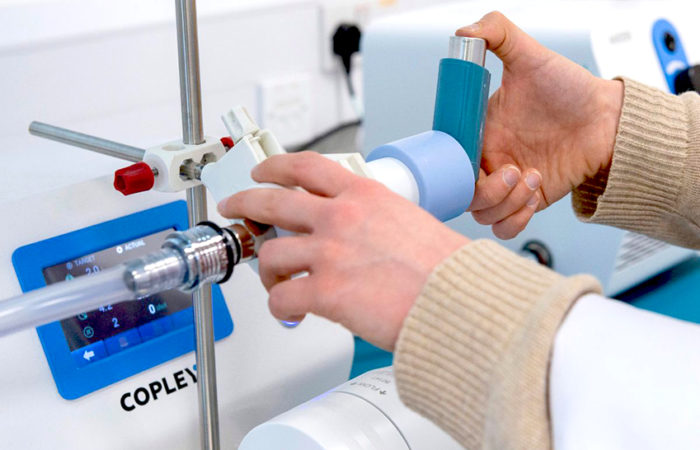
Add Simple Features to Benefit Patient Use: It is imperative that designers fully understand patient needs and incorporate these into any device design. Innovative ideas should also be sustainable. An example of this is taking the simple plastic MDI actuator and redesigning it to be more sustainable and also to offer patient benefits (Figure 1).

Figure 1: Redesigned sustainable MDI Actuator.
These are just a few of the opportunities that pharma – and, just as importantly, its suppliers – could incorporate into shared industry guidelines. If these guidelines are followed, recycling would become more efficient and effective. There is a certain amount of alignment between some pharma companies via the Pharma Manufacturing Forum Emission Reduction Memorandum.11 This 2023 memorandum captures top-level acknowledgement that the industry has to work together and proposes initiatives for suppliers to report their emissions (primarily Scopes 1 and 2), but there is also the opportunity to detail Scope 3 Category 1 emissions (purchased goods and services). This is where DfS really counts and, if these are to be implemented, pharma must drive these opportunities together.
COMPLETING THE CIRCLE
Pharma packaging and device circularity is the ultimate goal for the industry. Making these components more recyclable is a major part of the challenge, and the opportunities highlighted above begin to make this more achievable. The major task is making disposal less linear and more circular. So, what currently happens to used medicine packaging and devices?
The sad truth is that, currently, most used medicine packaging and devices end up in landfill, crudely calculated to be between 85–95%. Note that early inhaler recycling pilots had a return rate of less than 1%.12 The current choices for packaging and device disposal in the UK (and many other countries) are:
- Landfill: Unfortunately, this is where the vast majority of used packaging goes.
- Incineration: An option used in controlled healthcare systems.
- Recycling: To date, there is no national capability – this needs to change.
Landfill is the worst scenario. There is the key risk of contamination, as well as it offering no circularity. Incineration of medicinal waste is typically undertaken at defined high temperatures with very limited waste-to-energy usefully recovered, but it is better than landfill. The last option is recycling. This can offer circularity if managed well, and this route could ultimately be implemented by following the guidelines detailed above.
A major challenge with medical recycling is collecting used packaging efficiently. The inherent value of any medicine pack is the medicine itself. As mentioned prior, used medicine packaging cannot make use of kerbside collection. Schemes proposing the use of postal services have come up against issues such as pack size (in that they may not fit through some letterboxes), security, cold chain requirements and cost. In the UK, a Ventolin (salbutamol, GSK) MDI costs £1.50, the alternative Ventolin dry powder inhaler (DPI) variant costs £1.99.13 A second-class stamp to return these is £3.50. Any return strategy must be viable, robust, affordable and scalable.
With this in mind, many common chronic diseases typically require the patient or carer to return to the pharmacy for repeat prescriptions. This could be the ideal reverse-logistics opportunity to return used packaging and also for the pharmacist to ensure compliance – it is well known that 30–50% of medicines are not taken properly,14 and poor adherence is never sustainable. Currently some injectors are returned in sharps bins for incineration, but this is not widely mandated. Historically, there have been take-back schemes for inhalers that have come and gone, with the reasons for poor uptake including lack of alignment, lack of ongoing communication strategies for all stakeholders and lack of viability due to low return rates.
A new national take-back scheme has recently started in the UK,15 although, unfortunately, it currently only collects MDIs. The aluminium MDI aerosol cans have a high recycling rate and the plastic actuators can also be recycled (although plastics can only be reprocessed a limited number of times). Importantly, any residual propellant can be recovered and reused. With the new low-GWP propellants, this will still be a valuable capability. The scheme has the capacity to recycle 200,000 MDIs per day and the higher the volume returned, the more viable the scheme will be. The commercial success of this scheme will be worth following as such schemes do not come without running costs. Ideally, there should be the additional opportunity to extend it to other inhaler platforms – a key factor, as some patients have already switched to DPI devices for sustainability reasons. Furthermore, why not include injectors and other combination platforms? Expired EpiPens seem an ideal device to target.
“PUT SIMPLY, RECYCLING ENABLES PACKAGING AND DEVICES TO USE MANDATED QUALITY MATERIALS THAT
PERFORM TO EXACTING STANDARDS AND MEET CUSTOMER EXPECTATIONS ON SUSTAINABLY.”
This obviously involves specialist recycling but, if the industry is to meet sustainability expectations, it has to think differently and turn words into actions. Put simply, recycling enables packaging and devices to use mandated, quality materials that perform to exacting standards and meet customer expectations on sustainably. It is achievable, proven and takes the industry towards device circularity.
FURTHER OPPORTUNITIES FOR ENHANCED SUSTAINABILITY
Device Training
As mentioned, adherence is a known ongoing issue, especially with combination device platforms.16 Human factors testing and effective ergonomic design, coupled with clear instructions, can help to mitigate this risk. Effective training and training aids can help to optimise patient use,17 especially with combination products. An associated training programme should be implemented with any new platform device development.
Patient Instruction Leaflets
It is mandatory to supply instructions for use (IFU) with every medicine pack. These should include clear recycling instructions for all packaging and device components. There is an opportunity to remove leaflets and use QR or serialisation codes. This could provide more in-depth information, which would in turn reduce pack size and manufacturing complexity. Patients without phone or internet availability could have the IFU printed in the pharmacy. Any updated leaflets would be rapidly available with this digitisation, a latent additional safety benefit. Trials with digital leaflets are already underway.18

Figure 2: MDI Plus.
Cartons
Typically, every medicine is supplied in a carton. These cartons are recycled via kerbside collection, and there is again the opportunity to add recycling information for all of the packaging and the device on the carton (following sustainable printing guidelines). There is also potential for innovation with cartons, such as the MDI Plus (MDI PLUS, Kildare, Ireland), which repurposes the MDI carton as a spacer (Figure 2). This has been shown to be clinically (and cost) effective and it is not only sustainable but also offers genuine patient access to optimised medicine delivery.
Cold Chain Packaging
With increasing global use of glucagon-like peptide-1 (GLP-1) injectors and vaccines, the demand for cold-chain storage is ramping up. This is inherently carbon‑intensive because it relies on heavy insulation, refrigerants and single‑use materials. Strict controls and standards have to be adhered to with the use of cold-chain materials, and there is again an opportunity to innovate. One such innovative material is PluumoPlus (AEROPOWDER, Northampton, UK). This innovation uses bird feathers, which are repurposed into a proven, cost-effective and highly efficient thermal packaging solution suitable for life science applications.
Refillable Devices
Refillable devices are typically a more sustainable option. For example, capsule-based inhalers are both well established and clinically proven. However, capsules do need to be protected, so existing laminate materials are being replaced with more sustainable alternative packaging. Complex devices, such as Respimat by Boehringer Ingelheim, have transferred to a refill-based approach. Any refillable device should be simple to refill (proven through human factors testing), have a defined useable life, use minimal materials for the refill pack and be fully recyclable at end of life.
Electronics
Electronics are not easy to recycle. If they are to be used (and can be proven to enhance compliance), they should be reuseable and detachable. History has highlighted the challenges of using captive electronics in a combination device (e.g. DigiHaler by Teva) and consideration should be given to cost, regulations (e.g. the EU’s Waste from Electrical and Electronic Equipment Directive), supply chain component complexity, software, robustness and potential battery risks.
Shelf Life
Medical products must offer a minimum shelf life. With complex and extended supply chains, medicines run the risk of having to be written off and destroyed as they near the end of their shelf life. This is a hidden – and often unmeasured – cost that also bears an environmental impact. There is an opportunity with certain medicines to optimise packaging to extend shelf life. However, desiccants are not easy to recycle, so care must be taken when considering their use.
“INNOVATIVE DESIGN AND ‘SPECIFICATION FOR SUSTAINABILITY’, COUPLED WITH INDUSTRY-WIDE COMPLIANCE TO SUSTAINABILITY GUIDELINES WILL NOT ONLY HELP MEET SUSTAINABILITY TARGETS BUT ALSO ENABLE MORE EFFICIENT AND EFFECTIVE RECYCLING, DRIVING UP CIRCULARITY.”
CONCLUSION
Designing sustainable pharmaceutical packaging and combination devices requires a multidisciplinary approach that integrates environmental science, engineering, user behaviour and policy. Innovative design and “specification for sustainability”, coupled with industry-wide compliance to sustainability guidelines will not only help to meet sustainability targets but also enable more efficient and effective recycling, driving up circularity. To achieve this end goal, pharma will require suppliers, healthcare systems, patients and recyclers to be key partners in this future vision. Regulatory momentum and patient awareness are accelerating this transition, but success will rely on continued innovation, cross-sector collaboration and a commitment to clinical excellence alongside environmental responsibility.
REFERENCES
- “The Carbon Impact of Biotech & Pharma: Crossing the Tipping Point of Industry Transformation”. Report, My Green Lab, Nov 2024.
- Nève A, Violato N, “The Puzzle of Sustainable Pharma Packaging: Drivers, Trade-Offs, and Best Practices”. Pharmaceutical Engineering, Nov/Dec 2025.
- Seeney P, Winkworth P, Nelson C, “Making Sustainability by Design the Lintel of Sustainable Inhaler Development”. ONdrugDelivery, Issue 139 (Oct/Nov 2022), pp 50–55.
- “Beyond the Box: Cutting-Edge Packaging Technologies Shaping the Future of Retail”. European Business Magazine, May 2023.
- “Delivering a ‘Net Zero’ National Health Service”. Report, UK NHS, Oct 2020.
- “The Global Commitment: a common vision for a circular economy”. Web Page, Ellen MacArthur Foundation, accessed Apr 2026.
- “Respiratory – Carbon Impact dashboard”. Web Page, UK NHS, accessed Apr 2026.
- “FMCG Packaging Market Size & Share Analysis – Growth Trends and Forecast (2026-2031)”. Report, Mordor Intelligence, Jan 2026.
- “RECOUP Recyclability by Design 2024”. Report, RECOUP, 2024.
- Thielen M, “Bioplastics – Basics. Applications. Markets.” 2020, Polymedia Publisher.
- “Emissions Reduction Memorandum”. Pharma Manufacturing Forum, 16 Mar, 2023.
- Robertson J, “Patients encouraged to return used inhalers to pharmacies”. The Pharmacist, Feb 2025.
- “Inhaler Costs”. Web Page, NHS Grampian, accessed Apr 2026.
- Brown MT, Bussell JK, “Medication Adherence: WHO Cares?”. Mayo Clin Proc, 2011, Vol 86(4), pp 304–314.
- “Inhaler collection and recycling service”. Web Page, Grundon, accessed Apr 2026.
- “Pharmacists could save the NHS billions of pounds with medicines checks, according to analysis by University of York”. University of York, Oct 2025.
- Sanders M, Murnane D, “Inhaler Technique mastery; focus on LEARNING rather than TRAINING”. DDL Proc, 2023, Vol 34, pp 29–32.
- Nauwelaerts K, Tellner P, “Electronic Product Information (ePI) – Making the latest medicine’s information available for patients without any delay”. The EFPIA View, Nov 2022.