

To Issue 185
Citation: Garska B, Schlecht S, “Rethinking Drug Delivery: Enabling Recycling and Material Efficiency in Healthcare”, ONdrugDelivery, Issue 185 (Apr/May 2026), pp 40–44.
Dr Bernd Garska and Sven Schlecht highlight how single-use drug delivery devices can be re-thought to help solve the climate and environmental challenges in the healthcare sector.
The healthcare industry is crucial for global wellbeing; however, it comes at a significant environmental cost. If the global healthcare industry were a country, it would rank as the fifth-largest emitter of greenhouse gases (GHGs), contributing nearly 4.4% of global net emissions and emitting over 2 gigatons of CO2 equivalents annually.1
“DRUG DELIVERY DEVICES PRESENT A PARTICULAR CHALLENGE FOR A CIRCULAR ECONOMY DUE TO THEIR OFTEN-COMPLEX MATERIAL COMPOSITION, SMALL SIZE AND POTENTIALLY CONTAMINATED PARTS.”
The covid-19 pandemic further highlighted this issue, generating millions of tonnes of medical plastic waste, much of which was either incinerated or sent to landfill due to infection risks or material complexity. Studies also found that a significant percentage of medical plastics during the pandemic were single-use, emphasising the scale of the challenge.2 This reality underscores the urgency of redesigning how plastics are used in healthcare, with sustainability as a core principle. With an urgent need for a circular economy in healthcare, achieving this goal requires innovation across materials, designs and recycling pathways; healthcare organisations must become thought leaders in sustainability.
Drug delivery devices present a particular challenge for a circular economy due to their often-complex material composition, small size and potentially contaminated parts. These factors make them difficult to handle in conventional plastics waste management systems.
Three fundamental approaches to re-imagining single-use drug delivery devices to help solve environmental challenges in the healthcare sector include:
- Bio-circular-attributed feedstocks3 for immediate footprint reduction
- Smart design and material selection to reduce wall thickness and reduce material complexity
- Make use of attractive (new) recycling pathways (technically and commercially).
BIO-CIRCULAR FEEDSTOCKS FOR CARBON REDUCTION
An impactful choice for more sustainable designs lies upstream at the material selection stage. Selecting a plastic material produced with alternative, bio-circular raw materials, as defined by International Sustainability and Carbon Certification (ISCC) Plus,3 can offer a scalable solution for reducing the carbon footprint of a medical device from the outset. By changing from purely fossil-based plastics to equivalent grades with certified attributed share, manufacturers of drug delivery devices can reduce their of Scope 3 emissions, while still maintaining the high-performance characteristics required in medical devices.4
Bio-circular-attributed polycarbonates (PCs), for example, are produced with raw materials that are chemically identical to those used in standard PCs. However, a defined share of these raw materials is related to biological waste and residual streams, such as used cooking oils or biomass residues, instead of crude oil. Through the mass-balance approach, these alternative raw materials are fed into production and yield PCs that are identical in performance, processability and regulatory compliance to their conventional counterparts, yet offer a significantly reduced carbon footprint.4
“AFTER POLYMERISATION, THE MATERIAL IS INDISTINGUISHABLE IN MOLECULAR STRUCTURE AND RETAINS THE PERFORMANCE CHARACTERISTICS OF CONVENTIONAL PC, ENSURING SEAMLESS INTEGRATION INTO EXISTING MANUFACTURING PROCESSES.”
Substitution of carbon from fossil-based feedstocks with carbon from bio-circular feedstocks begins with the extraction of carbon from sources such as used cooking oil. These materials undergo processing to make them amenable to the conventional processes that are typically used to extract hydrocarbons (e.g. phenol and acetone) from crude oil, which are then refined into the same chemical raw materials required for the synthesis of PCs. After polymerisation, the material is indistinguishable in molecular structure and retains the performance characteristics of conventional PC, ensuring seamless integration into existing manufacturing processes. Equivalence studies have been conducted to support and simplify regulatory assessments.
Solutions such as Covestro’s Makrolon® RE PC provide ISCC PLUS-certified3 bio-circular-attributed drop-in alternatives to existing healthcare applications already using PC. These grades can claim up to 89% bio-circular-attributed content, offering a reduction in carbon footprint compared with fossil-based PC.5,6
Mass-balance accounting, following guidelines laid out by the ISCC, ensures transparent tracking of renewable content, third-party verification and regulatory-aligned carbon reporting. With ISCC certification, Scope 3 carbon reductions can be transferred, or claimed, aligning with the goals of the EU Green Deal, Corporate Sustainability Reporting Directive and GHG Protocol frameworks.2,7, 8 Importantly, this approach emphasises that sustainability starts at the molecular level; choosing renewable attributed feedstocks for the production of plastics reduces the amount of carbon derived from fossil sources, which has a direct impact on the carbon footprint of devices produced with this bio-feedstock-attributed plastic.4
“SIGNIFICANT ENVIRONMENTAL IMPROVEMENTS ARE ACHIEVABLE WITHOUT COMPROMISING ON DEVICE PERFORMANCE OR PATIENT SAFETY.”
Case Study: Over 90% CO2 Reduction
In a recent case study, Covestro demonstrated that a multi-component drug delivery device, produced using Makrolon® RE and manufactured with electricity from renewable sources (e.g. wind power), could reduce the product-level carbon footprint by over 90% relative to the same device made with conventional fossil-based PC.6 The resulting carbon footprint reduction demonstrates that significant environmental improvements are achievable without compromising on device performance or patient safety.
It is also worth noting that the adoption of materials derived from bio-circular feedstocks not only helps to reduce the global consumption of fossil-based materials but also reduces risks from exposure to either emerging corporate environmental, social and governance mandates that emphasise carbon footprint reduction or international policy frameworks. The benefits of either revising existing devices that use conventional PC or developing new designs with renewably sourced materials, such as Makrolon® RE PC, represent a huge contribution that device manufacturers can make towards more sustainable healthcare.
REDUCING MATERIAL USE THROUGH MORE SUSTAINABLE DESIGNS
Material efficiency is both an economic and environmental imperative in modern product design. Minimising material usage complements strategies that use sustainable materials, further reducing the overall environmental impact of medical devices. Beyond lowering the fossil-based carbon usage of the materials of construction, efficient design minimises transport weight, energy use during moulding and waste generation.6,9
The physical properties of PC – in particular the combination of rigidity and ductility – enables designers to implement thin-wall designs without sacrificing mechanical integrity. Transitioning from conventional wall thicknesses to thin-wall geometries can result in a weight reduction of ~42%, while maintaining superior strength and rigidity compared with polypropylene or polyamide alternatives.6
This capability is particularly critical for autoinjectors and inhalers, where precision and mechanical reliability are critical. Advanced simulation techniques, including computational fluid dynamics and structural analysis, can enable designers to optimise part geometries for functional performance. This targeted approach ensures that material is used efficiently, with thicker sections only implemented where required. Simulations can also assist with the injection-moulding process design to ensure efficient manufacturing. It should also be noted that, within medical-grade PC ranges, multiple molecular weights are available to help balance the needs of performance and manufacturability.
The consistent mechanical properties and dimensional stability of PC across humidity conditions reduces design uncertainty compared with polyamide, whose properties vary significantly.9 The design of autoinjector components, such as bodies, plungers and strikers, illustrates this principle. Traditionally, high-stress components such as strikers require glass-fibre reinforced polyamide or polybutylene terephthalate, whereas advanced PC grades, such as Makrolon® M424LF, provide sufficient stiffness and low friction inherently, enabling drop-in replacements while simplifying material complexity and lowering the carbon footprint.6 Finite element method simulations confirm that PC strikers meet creep and durability requirements without resorting to excessive material usage, demonstrating how sustainable designs are intricately linked to material selection.
“IT SHOULD ALSO BE NOTED THAT REDUCTION OF
MATERIAL COMPLEXITY ALSO ENHANCES RECYCLABILITY
THROUGH EASIER SORTING AND STREAMLINES THE MOULDING STEPS.”
It should also be noted that reducing material complexity also enhances recyclability through easier sorting and streamlines the moulding steps. The physical properties of PCs can also help to enable new approaches to eliminate clips or fasteners that can complicate disassembly and sorting for recycling. Snap-fit designs, living hinges and integrated features can replace these elements while maintaining functionality.
HOW PC PAVES THE WAY FOR OPEN- AND CLOSED-LOOP RECYCLING IN HEALTHCARE
Beyond in-use performance, PC still retains much of its functionality after recycling, enabling its use in materials formulated with mechanically recycled PC. PC has been part of polymerase chain-reaction-containing materials for several decades, and the material is well-positioned to meet emerging demands for recyclate content in electronics and automotive applications.
Previous studies have shown that the stability of PC translates to consistent performance in recycled applications, with minimal degradation of mechanical properties through multiple recycling cycles.3 Studies have also shown that properly processed recycled PC can maintain its original impact strength and tensile properties, making it suitable for demanding applications even after recycling.
PC Simplifies Recycling for Healthcare
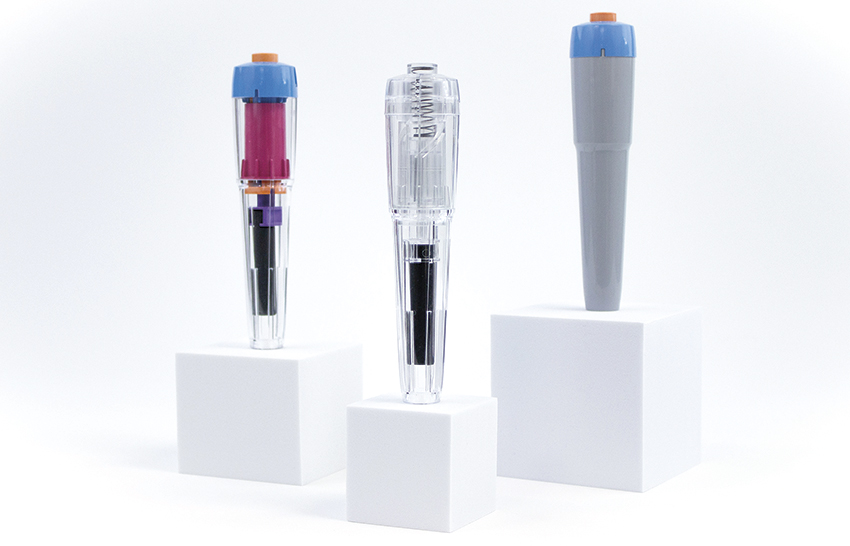
Covestro developed drug delivery device demonstrators composed entirely of PC-based plastic materials to illustrate how simplified materials can function together and simplify recycling. In this concept, medical-grade PC materials with desired functionalities (e.g. low friction or high creep resistance) simulated the functioning of a single-use autoinjector. Due to the inherent compatibility of the plastic components, separation for recycling was simplified by focusing solely on separation of glass and metal from plastics. Even with fully mixed plastic components, the resulting recyclate retained good properties, even after several re-processing steps. Lifecycle assessment calculations suggest that 100% recycled PC could reduce climate impact by up to 34%, and even 20% recycled content yielded a 7% CO2 reduction.10
Closed-Loop Recycling
Healthcare presents a significant challenge for use of recyclate; however, a 2024 study by Barbaroux et al evaluated the mechanical recycling of single-use PC bioreactor vessels used for research in the biopharma sector. The aim of this study was to assess the feasibility of setting up a closed loop to reduce both carbon footprint and plastics waste from a sector that relies heavily on single-use plastics. After autoclaving, vessels were shredded and reprocessed to make new ones. No significant changes were noted in cell compatibility or product quality, indicating that PC could support closed-loop recycling even in sensitive bioreactor applications.10

Figure 1: Mechanical recycling of mixed PC-centric waste.
Implementation of closed-loop systems (Figure 1) requires meticulous collection, decontamination and quality control protocols. However, the potential benefits can be substantial: reduced consumption of virgin raw materials, lower carbon emissions and decreased waste management costs. Several healthcare facilities have already implemented pilot programmes for closed-loop recycling of non-patient-contact plastic items, demonstrating the increasing efforts to make healthcare more sustainable.3,10,11
“BY RETURNING THESE MATERIALS TO THEIR MOLECULAR BUILDING BLOCKS, CHEMICAL RECYCLING CAN EFFECTIVELY ‘RESET THE CLOCK’ ON MATERIAL AGEING, SETTING THE STAGE FOR CIRCULARITY WITHOUT QUALITY LOSS.”
Chemical Recycling
Chemical recycling (Figure 2), which has made substantial advances in recent years, represents a complementary approach to mechanical recycling, which is particularly valuable for materials that have undergone multiple mechanical recycling cycles and begun to show degradation in properties. By returning these materials to their molecular building blocks, chemical recycling can effectively “reset the clock” on material ageing, setting the stage for circularity without quality loss.

Figure 2: Future chemical recycling of mixed PC-centric healthcare devices.
Chemical recycling breaks polymers down into monomers or chemical building blocks that can be reused for synthesis of polymers, which are indistinguishable from virgin materials.12,13 In certain cases, such a process can even address the challenge of multi-material devices and enable genuine circularity.
PC’s outstanding retention of properties in mechanical recycling stems from the stability of the material. This stability has presented a particular challenge for chemical recycling of PC, but recent advances have made this not only possible but also scalable, energy-efficient and environmentally responsible. Covestro’s new RP series marks the company’s first product line linked to chemically recycled post-consumer waste, which is designed to address end-of-life expectations. The RP suffix refers to chemically recycled attributed plastics that combine high purity with the use of secondary raw materials while maintaining the performance and quality of primary fossil-based PCs.14 Covestro incorporates two key practices into the production process: the use of alternative raw materials attributed with chemically recycled content through mass balancing, and the allocation of energy from renewable sources at selected production sites.
In addition, Covestro has developed a new chemical recycling process for PC, overcoming the last barrier to full circularity for this material and establishing a viable process to break down PC into its monomer, which can be re-polymerised to yield high-quality PCs again. Covestro has expanded beyond lab-scale and is setting up a pilot-scale facility.15
CONCLUSION
The path to more sustainable drug delivery is clear – PC-based devices designed for recycling and material efficiency can help to reduce the healthcare sector’s environmental footprint. Using bio-circular feedstocks, thin-wall smart design, mechanical recyclability and chemical recycling, manufacturers can achieve tangible carbon footprint reductions, lower plastic consumption and attain circularity at scale.
The transition to sustainable healthcare devices represents not just an environmental imperative but also a strategic business opportunity. As regulatory frameworks increasingly demand extended producer responsibility and carbon accountability, organisations that proactively embrace circular design principles will gain competitive advantages in market access, stakeholder trust and operational resilience.
REFERENCES
- “Health Care’s Climate Footprint”. Health Care Without Harm, Sep 2019.
- Uddin MA et al, “Environmental impacts of personal protective clothing used to combat COVID-19”. Adv Sustain Syst, 2022, Vol 6 (1), art 2100176.
- Moulinié P, Platte I, Zetts L, “Designing Drug Delivery Devices to Meet Emerging Needs and Sustainability Goals”. ONdrugDelivery, Issue 132 (Apr-May 2022), pp 24–28.
- “RE Series Enables Significant Reduction of CO2 Footprint*”. Company Web Page, Covestro AG, accessed Apr 2026.
- “ISCC PLUS Mass Balance Guidance Document”. ISCC Guidance. Accessed Apr 2026.
- Garska B, Ruesta J, “Circular solutions from Covestro toward full circularity in the healthcare industry” . Webinar, Covestro, accessed Apr 2026.
- “Corporate value chain (Scope 3) accounting and reporting standard”. World Resources Institute & World Business Council for Sustainable Development, 2011.
- “Circular Economy Action Plan. The European Green Deal”. European Commission, Mar 2020.
- “PBT vs. Nylon (PA): Which Engineering Plastic Should You Choose?”. Company Web Page, AAP. Accessed Apr 2026.
- Barbaroux M et al. “Concept for recycling a small-scale plastic-based bioreactor in a close-loop – Technical approach”. J Clean Prod, 2024, Vol 471, art 143436.
- “High-Performance Materials for Healthcare Applications”. PDF, Covestro AG. Accessed Apr 2026.
- Rahimi A, García J M, “Chemical recycling of waste plastics for new materials production”. Nat Rev Chem, 2017, Vol 1, art 0046.
- Li H. et al, “Expanding plastics recycling technologies: chemical aspects, technology status and challenges”. Green Chemistry, 2022, Vol 24, pp 8867–9332.
- “RP series provides a second life to chemically recycled post-consumer waste”. PDF, Covestro AG. Accessed Apr 2026.
- Covestro AG. (2024). “Chemical recycling of polycarbonates reaches a major milestone”. PDF, Covestro AG, Aug 2023.