

To Issue 184
Citation: Gilmore S, “Interview: Inside The Crux Technology Centre”, ONdrugDelivery, Issue 184 (Apr 2026), pp 16–19.
Q Crux recently opened its new Technology Centre in Bristol. What does this expansion represent for the company and the partners it works with?
A The opening of the Crux Technology Centre marks an important step forwards for our teams and the organisations we collaborate with across the healthcare sector. The investment reflects both the growth of Crux as a business and the increasing complexity of the programmes we support.
Over the past decade we have seen a significant shift in expectations around medical device development. Devices are no longer judged purely on technical performance; they must also deliver a high level of usability, reliability and confidence for clinicians and patients. Achieving that requires deeper integration between user research, design, engineering and applied science.
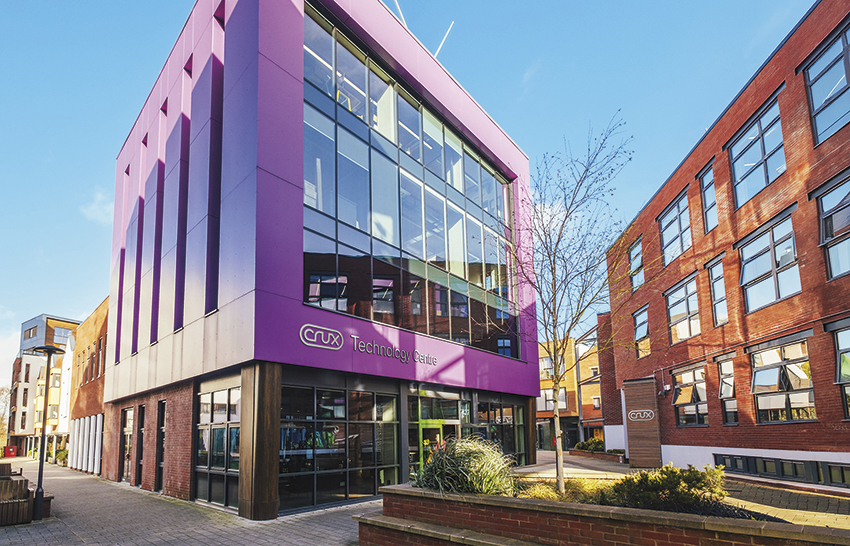
The new Technology Centre expands the environments where this work takes place (Figure 1). Our teams now have access to larger human factors facilities, expanded laboratories and specialist spaces that allow us to develop devices at a larger scale. At the same time, it increases our capacity to work with partners on complex development programmes that require close collaboration across disciplines. For our clients, the benefit is clarity earlier in development – they can see how devices behave in realistic environments, gather meaningful usability evidence and make informed decisions with greater confidence as projects move forwards.

Figure 1: The Crux Technology Centre and Crux Headquarters.
Q Human factors research appears to be a central feature of the new facilities – why has this area become so important in medical device development?
A Human factors has become fundamental to successful medical device development because it directly influences how effectively a device can be used and validated. In regulated environments, usability is closely linked to risk management. Regulators expect pharmaceutical companies to demonstrate that devices can be used correctly by their intended users in real-life contexts. That requires structured research, evidence gathering and a clear link between user insight and design decisions.
At Crux, we view human factors as an integral part of engineering development rather than a separate activity. By observing how users interact with devices, we can identify opportunities to improve user ergonomics, interaction and workflow very early in the process. This approach helps to remove uncertainty; instead of relying on assumptions or obsolete data about how a device might be used, teams can observe real behaviour, capture evidence and refine the design accordingly. The result is a development pathway that is both more efficient and more aligned with regulatory expectations.
Q How does the Technology Centre support usability research throughout the full device development process?
A The Technology Centre includes dedicated usability research rooms designed to support studies at every stage of development (Figure 2). Early-stage research often focuses on formative exploration, which may involve evaluating initial concepts, studying first impressions and identifying opportunities to refine the way a device is handled or understood. At this point, the goal is to gather insights that can inform decisions before engineering or design development progresses, whereas later-stage studies move towards formal human factors validation. These studies are conducted within structured protocols and generate the evidence required for regulatory submissions.

Figure 2: Usability research suite and viewing room in the Crux Technology Centre.
Having purpose-built environments for both types of work allows us to maintain continuity across the development journey. The teams who capture early insights can support validation studies later on, ensuring that design decisions are clearly documented and supported by evidence throughout development.
“ONE OF THE MOST IMPORTANT ADVANTAGES OF THE CRUX TECHNOLOGY CENTRE IS THE WAY IT CONNECTS DIFFERENT DISCIPLINES WITHIN A SINGLE ENVIRONMENT.”
Q The Technology Centre emphasises collaboration between research, engineering and design teams – how does that influence the pace and quality of development?
A One of the most important advantages of the Crux Technology Centre is the way it connects different disciplines within a single environment. Human factors research generates a continuous stream of insights about how devices are used, so that, when those insights flow directly into design and engineering development, design teams are able to respond quickly. Prototypes can be refined and reintroduced into testing environments within a short timeframe. This creates a development rhythm where observation, iteration and evaluation happen in close succession. It allows programmes to maintain momentum while still meeting the rigorous standards expected of regulated device development.
Q The expansion also increases Crux’s dry lab capabilities – how does this support testing and validation for medical products?
A The new Technology Centre significantly expands our dry lab facilities, effectively doubling the space available for testing and validation work (Figure 3). These laboratories enable our teams to evaluate the performance of medical devices under controlled conditions using specialised equipment. This includes mechanical testing, device characterisation and detailed analysis that supports engineering development and verification activities.

Figure 3: The Crux Technology Centre expands Crux’s dry-lab capabilities.
Q One of the most distinctive spaces in the new Technology Centre is the surgical research suite – how does this help teams evaluate device performance?
A The surgical human factors suite allows us to recreate clinical environments with a high level of realism; that context is extremely valuable when studying how devices are handled during complex procedures. Within the space, we can simulate operating room conditions and observe how clinicians interact with devices while carrying out realistic tasks. Usability experts can study hand movements, device positioning, workflow and communication between surgical team members.
These observations often reveal insights that are difficult to capture in more traditional testing environments. Small design elements, such as grip shape, feedback mechanisms or device orientation, can influence how confidently a device is used during a procedure. Both research suites also include adjacent viewing rooms where clients and usability specialists can observe sessions live (Figure 4). That shared visibility allows the entire development team to see how devices perform in the hands of real users and to discuss potential improvements immediately after study sessions.

Figure 4: Surgical research suite and viewing room in the Crux Technology Centre.
“BY DOUBLING OUR UK FOOTPRINT, WE HAVE CREATED SPACE FOR A GROWING WORKFORCE – OVER THE COMING YEARS WE EXPECT TO CONTINUE EXPANDING OUR TEAM OF MECHANICAL ENGINEERS, DESIGNERS, HUMAN FACTORS SPECIALISTS, APPLIED SCIENTISTS AND LIFE SCIENTISTS.”
Q The Technology Centre represents a significant investment in Bristol – how does the expansion help Crux foster new talent?
A The decision to expand in Bristol reflects a long-term commitment to the region and to the engineering sector more broadly. By doubling our UK footprint, we have created space for a growing workforce – over the coming years we expect to continue expanding our team of mechanical engineers, designers, human factors specialists, applied scientists and life scientists.
Equally important is the role the centre plays as a place for collaboration and exchange of ideas. The building includes a dedicated auditorium with capacity for more than 100 people, allowing us to host talks, industry discussions and guest speakers from across the sector. Bringing researchers, clinicians, engineers and technology leaders together in this way can help create valuable conversations around the future of medical device development.
Q The expansion also reflects broader growth across both the UK and the US. How does this international presence influence the way Crux works with partners?
A Our expansion reflects a deliberate strategy to strengthen our presence in two important regions for innovation. In the UK, the new Crux Technology Centre and the existing Crux Headquarters provide the infrastructure required to support a growing team and larger development programmes while remaining rooted in the region where the company was established. At the same time, our office in Kendall Square in Cambridge, Massachusetts (US) has developed rapidly. Being located within one of the world’s most active technology and life sciences ecosystems places us close to organisations developing the next generation of healthcare technologies, allowing us to collaborate more closely with our partners. Many programmes now involve teams operating across regions, combining expertise to deliver solutions at a global scale.