

To Issue 185
Citation: Maritan L, Ciavatti F, “Eco-Design Driving Nest and Ready-To-Use Packaging Innovation”, ONdrugDelivery, Issue 185 (Apr/May 2026), pp 34–38.
Lionel Maritan and François Ciavatti discuss RayDyLyo®, an eco-designed nest developed by ARaymond to reduce the overall impact of ready-to-use components, reflecting on insights gained from lifecycle assessments, outlining the progress still to be made and illustrating how a pragmatic, inventive, eco-centric design approach can drive the development of packaging solutions with a measurably lower environmental footprint.
“IN A SECTOR WHERE SINGLE-USE COMPONENTS AND PROTECTIVE FORMATS ENSURE QUALITY, RELIABILITY AND STERILITY, PROGRESS NOW RELIES ON VOLUNTARY, INDUSTRY DRIVEN ACTIONS.”
ENSURING PATIENT SAFETY WHILE DELIVERING SUSTAINABLE EVOLUTION
The pharmaceutical industry is undergoing one of the most significant transformations in its history. Scientific evidence makes the scale of the climate challenge unmistakable – at current emission rates, the world could exceed its remaining carbon budget for limiting global warming to 1.5°C within the next decade.1 Against this backdrop, the fill-finish industry faces a dual mandate: maintain patient safety and line performance while reducing its environmental impact.
In a sector where single-use components and protective formats ensure quality, reliability and sterility, progress now relies on voluntary, industry-driven actions.
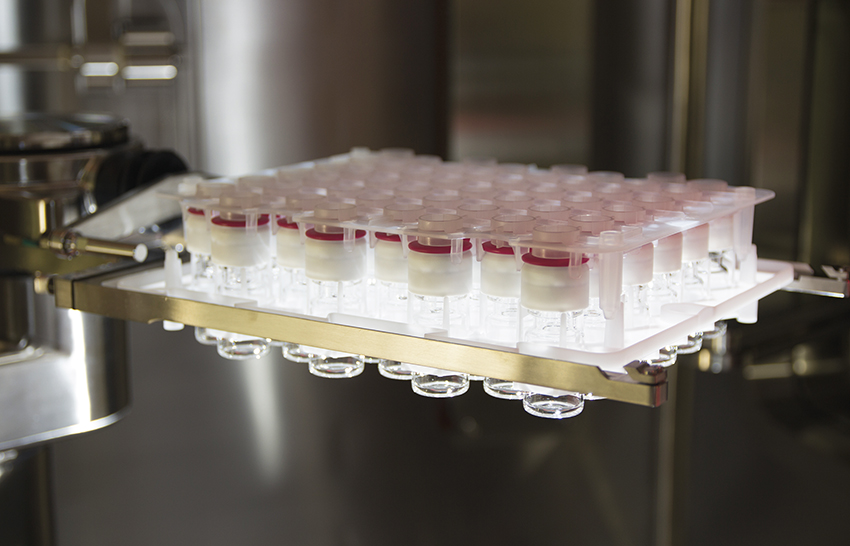
Within this context, ready-to-use (RTU) containers have become a cornerstone of modern aseptic processing. They reduce human interventions and enable automation in ISO 5/Grade A environments aligned with EU GMP Annex 1 expectations.2 At the same time, industry-wide assessments consistently identify primary packaging – and in some cases secondary packaging – as major contributors to the manufacturing-stage carbon footprint of parenteral products,3 making material and format decisions inseparable from environmental impact. As RTU formats expand beyond prefilled syringes to include vials and cartridges, attention is increasingly turning to how eco-design can guide next-generation components.
ECO-DESIGN AS A STRATEGIC LEVER FOR SCOPE 3 REDUCTION
For pharmaceuticals, products take years to develop and then remain on the market for decades, during which time any modification is tightly constrained.4 This makes upstream eco-design critical – the environmental performance of a component is largely determined long before it reaches commercial use.
At ARaymond, eco-design is a core driver of its innovation strategy and is fundamental to achieving the validated objectives of the Science Based Targets initiative. To deliver on these ambitions, ARaymond has introduced company-wide eco-design training programmes. Some are offered to over 5,000 employees, highlighting the contribution each person can make to this approach. Others focus specifically on product development teams (over 1,000 employees) and include, for example, advanced modules on lifecycle assessments (LCAs).
All training programmes are grounded in four “golden rules”, which now guide the company’s product development practices:
- Material choice
- Weight reduction
- Ease of disassembly
- End-of-life principles.
RayDyLyo is one of the first products to benefit from this approach, and its development has helped mature ARaymond’s eco-design methodology. It is a gamechanger for RTU vial closure systems (Figure 1).

Figure 1: Cross-section of the RayDyLyo cap showing its three assembled components with the embedded standard stopper and the standard RayDyLyo nest 13 mm (100 positions).
“RayDyLyo HAS ALREADY DEMONSTRATED ROBUST PERFORMANCE ACROSS CLINICAL AND COMMERCIAL FILL-FINISH OPERATIONS AS AN RTU, PRESS-FIT ALTERNATIVE TO ALUMINIUM CRIMPED SEALS.”
RAYDYLYO: AN RTU VIAL CLOSURE SYSTEM FOR INJECTABLES
Developed by the healthcare division of ARaymond, RayDyLyo has already demonstrated robust performance across clinical and commercial fill-finish operations as an RTU, press-fit alternative to aluminium crimped seals, meeting the mechanical, aseptic and operational requirements of modern fill-finish environments:
- One-Step Press-Fit Application: Delivers consistent, design-driven container-closure integrity and eliminates crimping-related variability, particle generation and stopper deformation.
- Enhanced Contamination Control Performance: Components are supplied sterile and RTU, qualified for use in ISO 5/Grade A environments and aligned with Annex 1 expectations for reduced mechanical complexity and minimised interventions.
- High-Throughput Compatibility: Supports manual clinical operations as well as fully automated lines operating above 300 units/min, without the need for crimping heads or secondary closing stations.
- Broad Dimensional Compliance with ISO 83621/ISO 83622 Vials and Stoppers: Facilitates seamless integration with existing customer references and reduces onboarding and requalification efforts.
- Reduced Operational Risk and Mechanical Failure Modes: Simplified handling, fewer moving components and the elimination of tool-dependent process steps.
- Lower Total Cost of Ownership: Reduced equipment architecture, a smaller classified area footprint (Grade A/B), fewer maintenance operations and improved process capability across campaigns.
- Full RTU Workflow Compatibility: Supported by a complete portfolio of secondary packaging solutions – including tubs and nests, rapid transfer port bags and standard bag configurations – ensuring alignment with established transfer, loading and aseptic handling processes used in isolator and restricted access barrier systems environments.
The RTU approach removes the washing, drying and depyrogenation steps, and eliminates the crimping operation. This reduction in mechanical complexity and aseptic interventions enables a more streamlined, automation-ready process (Figure 2).

Figure 2: (A) Comparison of a conventional bulk vial fill-finish process (B) an RTU workflow using RTU vials and RayDyLyo pressfit caps.
Why Did the Nest Come First?
ARaymond completed an internal cradle-to-gate LCA of the RayDyLyo RTU system, covering the closure, nest, tub and bags, but excluding the stopper. While not third-party reviewed, the study follows ISO 14040/ 14044 principles to ensure transparency, reproducibility and a consistent basis for comparing packaging configurations.5

Figure 3: (A) LCA contributions of each component in the system. (B) Share of the four main LCA stages.
The analysis showed that the RayDyLyo closure and its associated nest were the main contributors to the system’s environmental footprint:
- Nest as Main Contributor: The polybutylene terephthalate (PBT)-based nest represented one-third of the overall impact, making it the single largest contributor (Figure 3A). This reflects the relatively high footprint of PBT resin compared with commodity polymers, driven by its more complex synthesis route and higher embodied energy.
- Minor Contributors: Combined, the other packaging elements (tub, bags and Tyvek®) accounted for 16% of the total footprint within the study boundaries.
- Raw Materials Dominance: Materials accounted for 80% of the total footprint across most environmental indicators (Figure 3B). The extraction and production of virgin plastics typically have the most impact due to energy-intensive polymerisation processes and upstream petrochemical feedstocks.
Together, these insights clearly positioned the nest as the most impactful and technically feasible target for redesign – a component where significant environmental gains can be achieved without altering the fill-finish fundamentals.
RETHINKING THE NEST: AN ECO-DESIGN ENGINEERING JOURNEY
Unveiled at the latest Pharmapack Europe, the redesigned nest for 13 mm RayDyLyo caps showcases a proof of concept born from a blend of creative engineering and agile, iterative exploration.
A full reassessment of the nest architecture identified non-critical material zones and enabled geometry optimisation, while preserving functional performance and reinforcing Design for Manufacturing principles. Structural elements were minimised without compromising the rigidity required for handling, transport and high-speed aseptic filling.
Key outcomes included:
- Weight Reduction (~44%): The drop from 133 to 74 g is the single most powerful driver of environmental improvement. Reducing mass directly lowers impacts across multiple LCA indicators, from fossil resource use to climate change and cumulative energy demand.
- Material Transition: Switching from PBT to polyproplyene (PP) reduces embodied energy and improves the environmental profile of the nest. PP also offers lower density and better recyclability potential.
- Densification (~66%): The redesigned geometry increases packout efficiency from three to five nests per tub (Figure 4). This reduces the number of pallets shipped and stored, decreases the frequency of line replenishments in Grade A/ISO 5 zones and allows for potential warehouse and intralogistics improvements. By moving more product with fewer shipments and materials, the new configuration also reduces downstream waste generation and improves value chain efficiency for customers.
- Robust by Design: Design for Manufacturing was integrated from early concept generation stages. Moldflow® polymer flow simulations were used to validate the redesigned structure under real processing conditions.

Figure 4: Representation of tub densification. Five eco-designed nests can now fit in one tub.
ENVIRONMENTAL GAINS DOWN BY 25%
The cradle-to-gate LCA quantifies how the redesign affects upstream environmental burdens:
- Nest Level (Component): Compared with its former design, the new nest delivers an average of 63% overall impact reduction, including a 63% decrease in climate impact, a 50% cut in resource use and an 89% reduction in water consumption. It reflects the combined effect of weight and material changes.
- System Level (Nest + Tub + RayDyLyo Cap): The footprint of the whole RayDyLyo system decreases by 25% on average across all 16 environmental indicators – evidence that a targeted modification of the secondary packaging (nest) can meaningfully lower the footprint of the overall RTU closure system (Figure 5).

Figure 5: Relative reduction of environmental impacts across the 16 indicators between a current and eco-designed nest.
As the redesign remains within a fossil-derived material family, the improvement is consistently visible across all 16 markers. Alternative solutions – whether focused on resource efficiency or on fossil-free materials – will require systematic LCA-based trade-off assessments to ensure that transitions are controlled and genuinely beneficial.
While densification effects are less visible within these boundaries, the analysis highlights a point of methodological importance: increasing the number of usable units per transported and stored volume directly influences several downstream mechanisms typically captured within Scope 3 categories.
“EARLY DESIGN DECISIONS CAN SUPPORT DOWNSTREAM OBJECTIVES RELATED TO CIRCULARITY, RESPONSIBLE MATERIAL STEWARDSHIP AND MORE EFFICIENT USE
OF EXISTING INFRASTRUCTURE.”
From a broader lifecycle perspective, the results illustrate how early design decisions can support downstream objectives related to circularity, responsible material stewardship and more efficient use of existing infrastructure. The redesigned nest therefore demonstrates not only the improved upstream performance but also a structural capacity to enable lower-impact operations further along the value chain, even if these effects are not quantified within the present study.
A MEASURED START TOWARDS MORE SUSTAINABLE RTU PACKAGING
The eco-designed nest marks a meaningful first step, even though it remains a fossil-based, single-use medical-grade component aligned with today’s sterilisation and regulatory constraints. Achieving genuinely sustainable RTU packaging will require co-ordinated progress on several fronts:
- The development of next-generation polymers (recycled, bio-sourced or mass-balanced)
- Broader use of monomaterial or disassemblable architectures
- Stronger cross-industry collaboration to improve end-of-life pathways.
With this redesign, ARaymond has established a repeatable, LCA-guided eco-design methodology that will steer future developments across the RTU platform. Applying the same structured, data-driven approach when designing upcoming components will help to ensure that new solutions balance performance with measurable environmental gains. As ARaymond’s environmental product declarations undergo third-party verification, this methodology will reinforce the company’s role as a strategic sustainability partner in the fill-finish ecosystem – helping to shape more resource-efficient, resilient and climate-aligned pharmaceutical operations.
REFERENCES
- “Global Warming of 1.5°C. Intergovernmental Panel on Climate Change”. Special Report, IPCC, 2018.
- “Eudralex Volume 4 – GMP Guidelines Annex 1 – Manufacture of Sterile Medicinal Products”. EMA, Aug 2022.
- Loftus MJ et al, “The carbon footprint of different medication packaging items at an Australian tertiary hospital”. J Pharm Pract Res, 2025.
- DiMasi JA, Grabowski HG, Hansen RW, “Innovation in the pharmaceutical industry: New estimates of R&D costs”. J Health Econ, 2016, Vol 47, pp 20–33.
- “Ecoinvent Database v3.11”. Web Page, Ecoinvent, accessed Mar 2026.