


To Issue 184
Citation: Nazarzadeh E, “Acoustic Wave Platform Nebuliser for Inhaled Delivery of Biologic Therapies”, ONdrugDelivery, Issue 184 (Apr 2026), pp 40–44.
Dr Elijah Nazarzadeh reports on the applications of Nebu~Flow, an acoustic wave-based nebuliser platform, addressing the challenges associated with drug delivery to the lungs via more efficient aerosolisation, enabling precise inhaled delivery of life-changing treatments.
The ability of biologic medicines to specifically target the underlying mechanisms of a wide range of diseases has driven substantial interest and investment in their development. This momentum facilitated the rapid development and approval of the first messenger RNA (mRNA)-based vaccines during the covid-19 pandemic, highlighting the potential of novel therapeutic platforms and encouraging a more optimistic outlook for future drug development.
Despite these advances, the number of approved biologic therapies remains relatively limited, particularly for respiratory disorders. Currently, the approved treatments for such conditions are primarily monoclonal antibodies, administered via intravenous or subcutaneous injection. In contrast, RNA-based therapeutics are still emerging, with only 25 approved globally. Only a few of these novel therapeutics have been formulated, let alone approved for inhalation, a promising delivery route for biologics that offers high local drug concentration with reduced systemic exposure.1
Beyond the conventional formulation, stability and pharmacokinetic considerations associated with biologic drug development, additional challenges arise when developing these therapies for inhalation. In particular, device compatibility and aerosol performance requirements – such as achieving an optimal aerodynamic particle size distribution – present significant barriers.
Inhalation drug delivery systems generally rely on the dispersion of either dry powder or liquid formulations. Currently, the majority of RNA-based therapeutics under development for respiratory indications are formulated as liquids.2–4 This route typically requires fewer development steps than dry powder formulations and is often preferred in early-stage development, particularly for clinical evaluation.
Nebulisers are primarily used for pulmonary delivery of liquid medicines, applying energy to the formulations to generate respirable aerosols. However, this process can subject sensitive biologics to mechanical shear, thermal stress and interfacial forces, potentially leading to degradation, denaturation or loss of functional activity.
Vibrating mesh nebulisers are currently among the most widely used platforms in research and early development of RNA therapeutics, but even these advanced devices can have limitations. Reported challenges include shear-induced damage to large biomolecules, finite mesh lifetime due to vibrational wear, clogging of mesh apertures and the need for extensive cleaning and maintenance.5–7
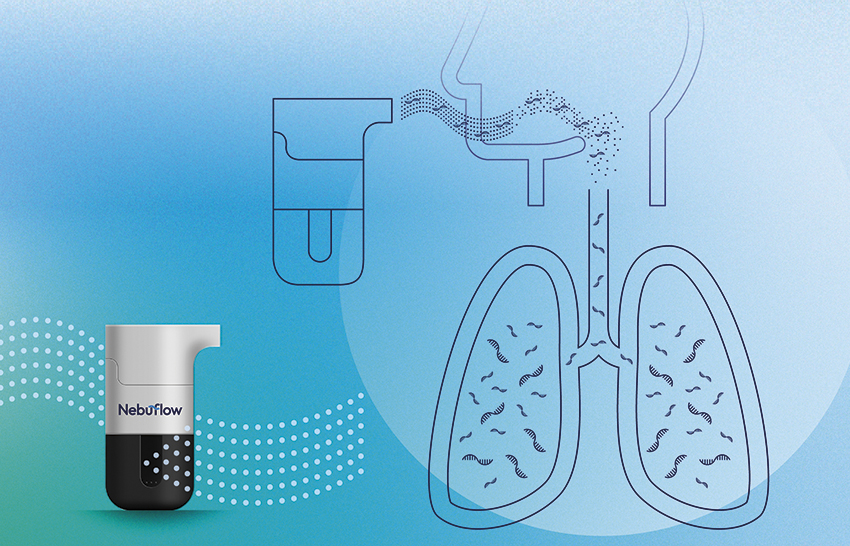
In contrast, Nebu~Flow® technology uses acoustic wave energy to aerosolise liquid formulations. With this platform, acoustic waves are generated on the surface of a piezoelectric substrate and transferred into the liquid along their propagation path, resulting in controlled aerosol formation.
Current evidence indicates that the technology can address many of the key mechanical and performance constraints of conventional nebuliser systems. In previous studies, Acu-Flow Limited demonstrated the capability of Nebu~Flow to generate fine aerosols with a fine particle fraction exceeding 90% for formulations containing small interfering RNA (siRNA). More recent investigations have shown that the platform can be tuned, enabling aerosol generation under reduced shear conditions. Furthermore, the system employs an energy transfer approach free of coupling layers, making the nebulising engine readily replaceable. This potentially eliminates the cleaning limitations associated with conventional mesh-based devices.8–10
The evaluated formulations span a range of molecular sizes and structural complexities, including antisense oligonucleotides (ASOs), conjugated siRNA, mRNA and plasmid DNA, as well as fragile liposomal and lipid nanoparticle (LNP) delivery systems. All studies were conducted within clinically relevant concentration ranges, based on previously reported data for each formulation.
Small RNA-based molecules
Both ASOs and siRNAs are short, synthetic nucleic acid therapeutics, typically fewer than 25 nucleotides in length, designed to modulate gene expression. Advances in chemical modification strategies have improved their structural stability, cellular uptake and resistance to nuclease degradation. Nevertheless, recent studies have indicated that nebulisation may induce oxidative stress, strand cleavage or conformational alterations in nucleic acid therapeutics, particularly under conditions involving elevated shear or interfacial stress.11
Antisense Oligonucleotides
Danvatirsen, a chemically modified, 16-mer, single-stranded, antisense gapmer targeting signal transducer and activator of transcription 3 (STAT3) mRNA, was selected as a model ASO. The compound was nebulised at clinically relevant concentrations (≥20 mg/mL). Aerosol samples were collected using a Next Generation Impactor (NGI) and evaluated for both structural integrity and biological activity.
Structural characterisation was performed using liquid chromatography-mass spectrometry (LC-MS). Analysis demonstrated no detectable structural modifications in the nebulised ASO compared with the non-nebulised reference (Figure 1), indicating preservation of molecular integrity following aerosolisation.

Figure 1: (A) Summary of purity and phosphorus-sulphur:phosphorus-oxygen ratio for all nebulised samples, compared with controls. (B) Results of ELISA showing potency levels of nebulised samples, compared with non-nebulised danvatirsen. Scrambled ASO was used as a control.
Biological activity was assessed in A431 epidermoid carcinoma cells using a STAT3 enzyme-linked immunosorbent assay (ELISA) to quantify target knockdown. Dose-response curves for all nebulised samples met predefined system suitability criteria (including R² values, asymptote ratios and slope ratios) and all samples satisfied assay acceptance requirements. Relative potency values ranged from approximately 87–129% compared with the non-nebulised reference, with variability consistent with the non-validated status of the assay (Figure 1B).
Importantly, all nebulised samples demonstrated clear STAT3 knockdown activity, confirming retention of functional potency following aerosolisation. Positive controls performed as expected, and non-nebulised reference samples exhibited relative potencies of 137% and 105%.
Small Interfering RNA
Chemical conjugation strategies, such as ligand attachment, are widely used to enhance siRNA stability, cellular uptake and pharmacological performance. In this study, a chemically modified, trivalent N-acetylgalactosamine (GalNAc)-conjugated siRNA was nebulised at a concentration of 100 µg/mL. This model system enabled assessment of both nucleic acid integrity and potential shear-induced detachment of the conjugated ligand following Nebu~Flow nebulisation.
The process involved size-fractionated aerosol sampling (<5 µm) conducted using a parafilm-modified NGI. Aerosol collected from all NGI stages was then pooled to generate one representative sample per nebulisation run. Structural integrity of GalNAc-siRNA was assessed using gel electrophoresis.
Bioactivity was evaluated by incubating nebulised samples with primary mouse hepatocytes at concentrations of 1 nM and 4 nM for 48 hours. Following incubation, cells were lysed and mouse transthyretin mRNA expression levels were quantified using TaqMan quantitative PCR and normalised to glyceraldehyde-3-phosphate dehydrogenase expression. The 4 nM condition served as a full-knockdown control (>95%), while the 1 nM concentration was selected to detect any reduction in activity attributable to nebulisation.
Gel electrophoresis analysis of triplicate samples generated using the Nebu~Flow nebuliser demonstrated identical banding patterns between nebulised samples and positive controls (Figure 2). The observed bands corresponded to intact GalNAc-siRNA, which migrated at a higher apparent molecular weight than unconjugated siRNA, confirming preservation of the conjugated structure following aerosolisation.

Figure 2: (A) Integrity of nebulised GalNAc-conjugated siRNA assessed via non-denaturing polyacrylamide gel electrophoresis (n=3). (B) Knockdown efficacy of nebulised GalNAc-conjugated siRNA in primary mouse hepatocytes with 3 replicates.
Functional assessment demonstrated >95% knockdown at 4 nM and >90% knockdown at 1 nM, indicating no measurable loss of biological activity, even at low concentrations.
Large RNA-based molecules
Shear forces generated during nebulisation are frequently implicated in fragmentation of large nucleic acids. Shear sensitivity increases with molecular length; therefore, plasmid DNA (>2,500 base pairs) was selected as a model to evaluate mechanical stress associated with aerosolisation. A commercially available vibrating mesh nebuliser was included as a benchmark comparator.
Structural characterisation of plasmid DNA before and after nebulisation was performed using a bioanalyser, enabling quantification of DNA strand size distribution (Table 1). Samples nebulised using the Nebu~Flow platform showed a ~1% reduction in the proportion of large plasmid species, compared with a >3% reduction observed with the mesh nebuliser. Additionally, mid-size fragment populations increased by ~4% following Nebu~Flow nebulisation, compared with >10% in samples processed using the mesh device.
| Sample | >3kb (%) | 1-3kb (%) | <1kb (%) |
| Non-nebulised | 19.7 | 11.6 | 68.7 |
| Nebu~Flow | 18.57 | 15.97 | 65.46 |
| Mesh | 16.53 | 23.03 | 60.44 |
Table 1: Extracted data from bioanalyser, showing the concentration of different sizes of Plasmid DNA fragments for non-nebulised (control) and nebulised samples from Nebu~Flow and a mesh nebuliser.
“THESE RESULTS INDICATE THAT THE NEBU~FLOW PLATFORM IMPOSES LOWER SHEAR STRESS RELATIVE TO CONVENTIONAL MESH NEBULISERS, RESULTING IN REDUCED FRAGMENTATION OF LARGE NUCLEIC ACID CONSTRUCTS.”
These results indicate that the Nebu~Flow platform imposes lower shear stress relative to conventional mesh nebulisers, resulting in reduced fragmentation of large nucleic acid constructs.
Lipid carriers for enhanced transfection of biologics
Biologic therapeutics, particularly large nucleic acids such as mRNA, require delivery systems to facilitate cellular uptake and enhance transfection efficiency. These delivery vehicles are typically lipid-based carriers, including liposomes and LNPs. Liposomes, composed of phospholipid bilayers, are generally larger and structurally more fragile than LNPs, making them a relevant and sensitive model for assessing shear-induced damage during aerosolisation.
In this study, liposomes encapsulating green fluorescent protein mRNA were formulated using the LipidBrick® system (Sartorius, Göttingen, Germany) according to the manufacturer’s protocol. The formulations were nebulised using the Nebu~Flow acoustic wave nebuliser platform and a commercially available vibrating mesh nebuliser as a comparator. The aerosol was then collected and condensed in a low binding vial. Post-nebulisation characterisation was performed using dynamic light scattering with a Zetasizer (Malvern Panalytical, Malvern, UK) to determine hydrodynamic diameter (Z-average), polydispersity index (PDI) and zeta potential. Encapsulation efficiency (EE) was quantified using a RiboGreen assay.
Nebulisation with the Nebu~Flow platform resulted in a minimal increase in liposome size (~15 nm), whereas samples processed using the mesh nebuliser exhibited a substantially larger size increase (~90 nm). The PDI of Nebu~Flow-treated samples remained close to 0.1, consistent with a monomodal and homogeneous size distribution. In contrast, samples aerosolised using the mesh nebuliser displayed markedly elevated PDI values, indicating significant disruption and heterogeneity in liposome populations.
These findings were further supported by changes in zeta potential and EE. Mesh-nebulised samples exhibited a shift toward more negative zeta potential values and a >25% reduction in EE, suggesting substantial mRNA leakage and carrier destabilisation. Free mRNA is unlikely to provide therapeutic benefit due to rapid degradation and poor cellular uptake.
Collectively, these results demonstrate that aerosolisation using the Nebu~Flow nebuliser platform preserves liposome structural integrity and mRNA encapsulation to a significantly greater extent than conventional mesh nebulisation, supporting its suitability for the aerosol delivery of fragile lipid-based mRNA formulations (Table 2).
| Sample | Z-average (nm) | PDI | Zeta Potential (mV) | EE (%) |
| Non-nebulised | 186.3±15.6 | 0.11 | 8.5±2.0 | 98.9±0.3 |
| Nebu~Flow | 202.2±6.8 | 0.12 | 6.7±1.1 | 98.4±0.1 |
| Mesh | 276±41.9 | 0.36 | -3.3±7.2 | 73.0±20.9 |
Table 2: Physical characteristics of liposomes before and after nebulisation. The Nebu~Flow nebuliser had the lesser impact, with no loss in mRNA load, compared with the non-nebulised sample. The mesh nebuliser caused a large change in liposome size and over 20% loss in mRNA load.
“UNLOCKING THE POTENTIAL OF INHALED RNA THERAPEUTICS WILL DEPEND ON THE DEVELOPMENT OF NEBULISER TECHNOLOGIES CAPABLE OF ADDRESSING THE CHALLENGES OF AEROSOLISING STRUCTURALLY SENSITIVE BIOMOLECULES.”
CONCLUSION
Unlocking the potential of inhaled RNA therapeutics will depend on the development of nebuliser technologies capable of addressing the challenges of aerosolising structurally sensitive biomolecules. Nucleic acid therapeutics are inherently vulnerable to shear, interfacial stress and potential oxidative degradation during aerosol generation. Their sensitivity increases with molecular size and structural complexity, particularly for conjugated siRNA, large plasmid DNA and lipid-encapsulated mRNA formulations.
The findings presented here demonstrate that the Nebu~Flow acoustic wave-based nebuliser platform efficiently aerosolises a broad spectrum of RNA-based therapeutics while consistently preserving their structural integrity and biological activity:
- For chemically modified ASOs, nebulisation using clinically relevant doses resulted in no detectable structural alteration by LC-MS and maintained full biological activity in a STAT3 knockdown assay.
- GalNAc-conjugated siRNA retained structural integrity and demonstrated preserved functional potency in primary hepatocytes, achieving >95% gene silencing at benchmark concentrations.
- For large plasmid DNA, the Nebu~Flow platform imposed substantially lower shear stress compared with a conventional vibrating mesh nebuliser, resulting in reduced fragmentation of high molecular weight nucleic acids.
- In lipid-based mRNA formulations, key determinants in delivery and therapeutic efficacy – liposome size distribution, surface charge characteristics and EE – were maintained with Nebu~Flow, whereas the comparator mesh device induced significant carrier disruption and mRNA leakage.
By providing a gentler and more tuned approach to aerosolisation, capable of supporting the inhaled delivery of shear-sensitive nucleic acid therapeutics across a wide molecular size range, Nebu~Flow may represent a promising platform to enable the clinical translation of inhaled RNA-based biologics.
ACKNOWLEDGEMENTS
The work described in this article is the result of a collaborative effort across the Nebu~Flow team. The author would particularly like to acknowledge Kiing Seng Wong, Niel Fullarton, Sarina Saeidi, and Ivona Ivanova for their outstanding contributions to the conceptual development, design and execution of the programme.
REFERENCES
- Gurbel PA et al, “First In-Human Experience With Inhaled Acetylsalicylic Acid for Immediate Platelet Inhibition: Comparison With Chewed and Swallowed Acetylsalicylic Acid”. Circulation, 2020, Vol 142(13), pp 1305–1307.
- Hu B et al, “Modulating tumor collagen fiber alignment for enhanced lung cancer immunotherapy via inhaled RNA”. Nat Comm, 2025, Vol 16, art 8120.
- Hennig M et al, “Inhaled DNAI1 mRNA therapy for treatment of primary ciliary dyskinesia”. PNAS, 2025, Vol 122(18), art e2421915122.
- Beike H et al, “Analysis of mRNA Delivery Performance via Vibrating Mesh Nebulization”. DDL Conf Proc, 2025, Vol 36, pp 328–331.
- Ari A, “Jet, Ultrasonic, and Mesh Nebulizers: An Evaluation of Nebulizers for Better Clinical Outcomes”. Eurasian J Pulmonol, 2014, Vol 16(1), pp 1–7.
- Pleasant RA, Hess DR, “Aerosol Delivery Devices for Obstructive Lung Diseases”. Resp Care, 2018, Vol 63(6), pp 708–733.
- van Rijn CJM et al, “Low energy nebulization preserves integrity of SARS-CoV-2 mRNA vaccines for respiratory delivery”. Sci Rep, 2023, 13(1), art 8851.
- Fullarton N et al, “Ultrafine siRNA-Laden Aerosol using Next Generation Nebulizer”. RDD Online, 2024, Vol 1, pp 359–362.
- Wong KS, Witte C, Tatnell D, Fullarton N, Nazarzadeh E, “An Acoustic Nebulizer Platform for Aerosolization of Biologics”. RDD Online, 2025, Vol 2, pp 192–195.
- Tatnell D, Wong KS, Fullarton N, Saeidi S, Witte C, Nazarzadeh E, “Optimisation of the Nebu~Flow Nebuliser to Enable Shear-Free Aerosolisation of Fragile Large Molecules”. DDL Conf Proc, 2025, Vol 36, pp 398–402.
- Seidl LL, Moog R, Graeser KA, “Antisense oligonucleotides and their technical suitability to nebulization”. Int J Pharm, 2024, Vol 661, art 124390.